Trajectoires de la peinture
an exhibition of Jean-Pierre Jouffroy
centre d'art de Bonneuil-sur-Marne — September 10-October 4, 2026
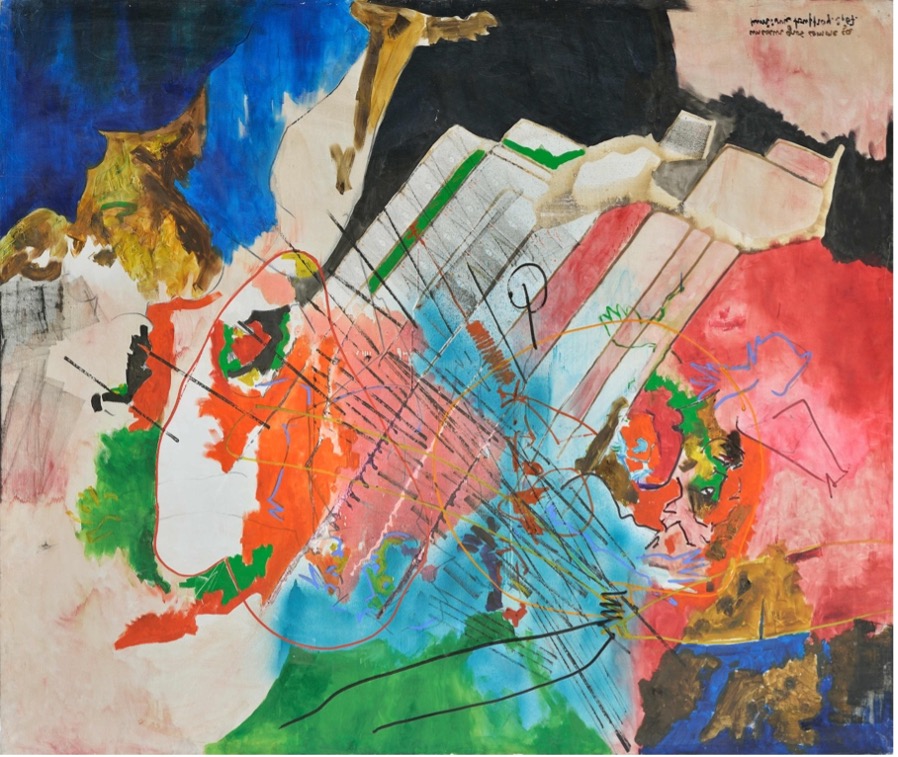
Painter, engraver, sculptor, and art critic born in Paris in 1933 and who died in Arcueil in 2018, Jean-Pierre Jouffroy was, above all, passionate about painting and painters. This exhibition offers an overview of the artist's powerful and distinctive work, presented without chronological markers. It is a dense presentation intended as a tribute and an opportunity to bring his seminal canvases back into view.
Through this selection of works, the exhibition allows us to appreciate a pictorial quest of rare intensity. In his luminous paintings, Jean-Pierre Jouffroy explores the territory of painting and deliberately disrupts the distinction between abstraction and figuration, in a sensitive pursuit of recurring motifs—portraits, landscapes, nudes—in an art that is ever denser and more richly textured.
His painting is characterized by pure, vibrant colors and almost abstract compositions, streaked with fluid, supple lines. Through his works, he expresses his feelings with great candor and remarkable optimism. For over sixty-five years of sustained activity, the artist blended awareness and political advancements, demonstrating a syncretic artistic universe, traversed by aesthetic dichotomies reflecting the society and world that was ours in the second half of the 20th century and the beginning of the 21st. Jean-Pierre Jouffroy always rejected conventions; passionate about both art and politics, he never abandoned subject matter for form.
The exhibition title is borrowed from Jean-Pierre Jouffroy's collection of critical texts, published in 2010 by Delga. It is also the first exhibition by the artist whose name graces the art center.
Curator: Ami Barak
Jean-Pierre Jouffroy emerged from the lyrical abstraction of the 1950s, from which he departed by rebuilding a figurative style that claims to use no figurative symbols.
Numerous exhibitions, including several retrospectives, have showcased his work in France and abroad, and his work is held in major institutions such as the Musée National d'Art Moderne, the Musée d'Art Moderne de la Ville de Paris, the Cabinet des Estampes, Brandeis University (Boston), and the Art Institute of Chicago.
Jean-Pierre Jouffroy was awarded a prize by the Society of Friends of the Musée d'Art Moderne in 1957 and by the Académie Française in 1973. He is known for his long series of engravings: fifty plates for "The Rape of the Sabine Women" in 1969, and one hundred plates for "Forty Human Figures" in 1983. In 1952, he replaced wood with acrylic glass and the gouge with a dental drill. It was using this technique that he engraved the forty plates for Paul Éluard's "Au rendez-vous allemand" (At the German Rendezvous), and he is also responsible for the book's layout. The twenty-seven poems, originally published in December 1944 (Éditions de Minuit), had never before been published in an edition illustrated with original engravings.
In November 1998, Maurice Rheims of the Académie française wrote: "For a long time, nearly half a century, I have observed with admiration and emotion the painted, drawn, and engraved work of Jean-Pierre Jouffroy. One might have thought that the artist had finished astonishing us, until the exhibition organized in the immense CGT building, the size of the Sistine Chapel, freed from all constraints, which allowed Jean-Pierre Jouffroy to give free rein to his creativity. Paintings of pharaonic dimensions, a kind of burst of laughter, as if Rabelais had decided to paint." For me, Jouffroy is absolutely amazing.