The Broken Corner of the Cube
Oláh Gyárfás
Art Encounters — Casa Isho, Timișoara — April 17-June 6, 2026
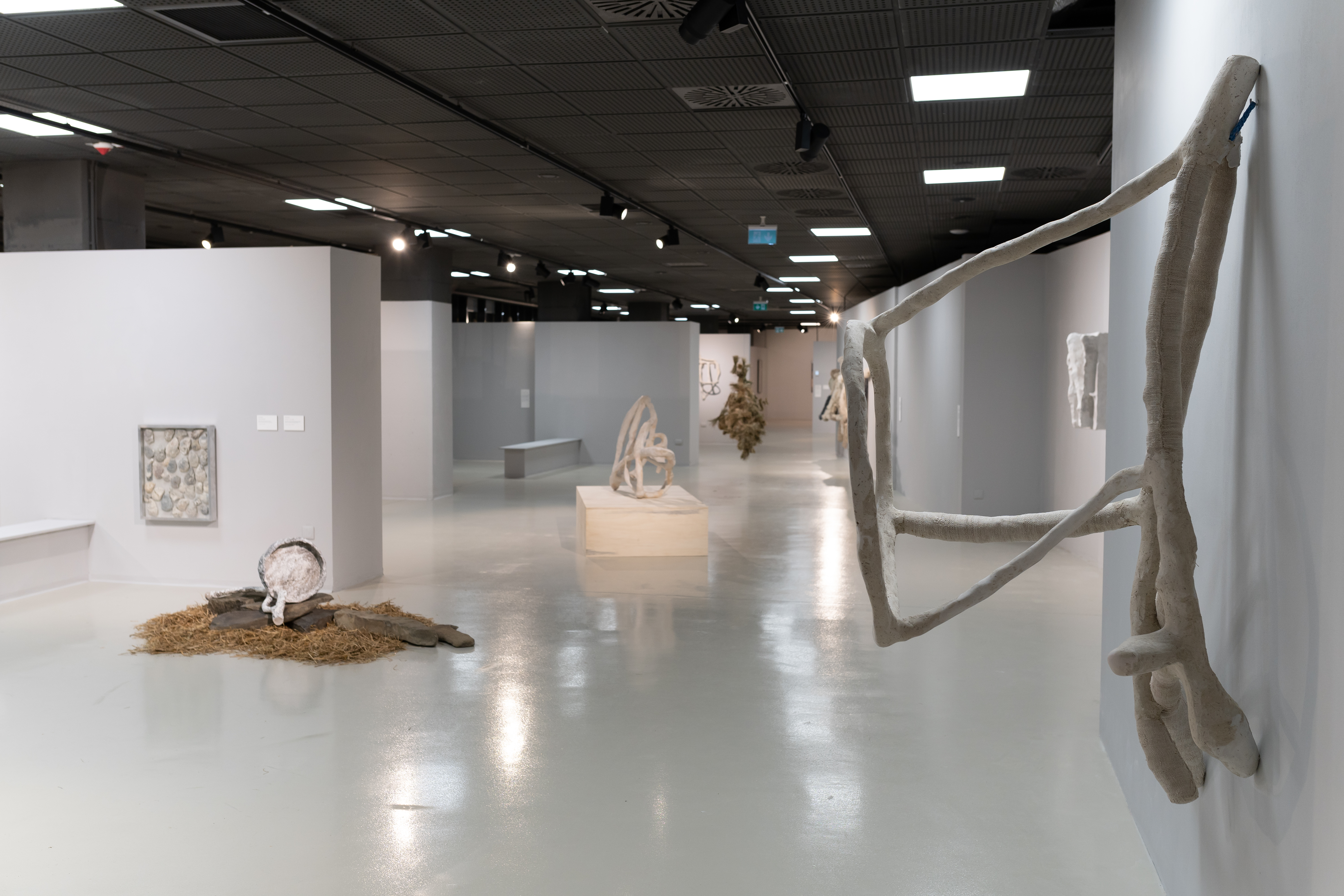
Oláh Gyárfás (b. 1975, Tușnad, Romania) is an artist in his own right, though he is still regarded as a designer who has strayed from his original path. The multifaceted and inventive nature of his creations leads us to consider him a great talent who knows how to captivate his audience and craft compelling narratives. Appreciated for his exploration of the archetypal relationships between human beings and the vegetable and animal worlds, his anthropomorphic sculptures, rendered in light, sandy tones, are produced using environmentally responsible methods. Interested in folk traditions, he uses old textiles to (re)create ghosts from the past or mythology. In his works, the relationship between art and craft is ubiquitous. Whether working with hay, wood, stone or ashes, the artist pays particular attention to the history and processes each material undergoes. In his art, the monsters of our collective imagination become both psychopomp creatures—which accompany the souls of the dead—and companion creatures, whose sculptural power is imposing and protective. The artist is interested in the coexistence of worlds as well as the interaction between seduction and anarchy, art and fashion, design and sculpture, object and identity.
In "The Lesson on the Cube," Nichita Stănescu (1933–1983) says that after you have carved a perfect cube from a stone, you take a hammer and chip off a corner. "Everyone will say: 'What a perfect cube this would have been, if only that corner hadn’t been chipped off!'" In the same way, Gyárfás experiments with semantic lyricism, cultivating existential symbols. He shifts meaning through metaphorical constructions, his approach being an interweaving of signs and hooks. The sign is the common meaning of what we see, and the hook is the semantic core of the imagined universe.
Gyárfás Oláh (b. 1975, Tușnad, Romania) is interested in folk traditions and uses old textiles to (re)create ghosts from the past or mythology. A recurring reference in Oláh’s sculptures is the relationship between art and craft. Whether it is textile, hay, wood or stone, the artist bestows careful attention to the history and the processes that each material undergoes, an aspect that constitutes an integral and important part of his sculptural practice. In Oláh’s work the monsters of our collective imagination become both psychopomp creatures – who accompany the souls of the dead – and pets, whose sculptural strength is at once imposing and protective. His archaic, hybrid sculptures open up a transitional space between different worlds, societies and eras.